
September 7, 2026: Young Prakhar Purohit, a student from North Carolina, saw an opportunity to make use of contaminated waters. His groundbreaking experiment turned waste into tightly contained energy.
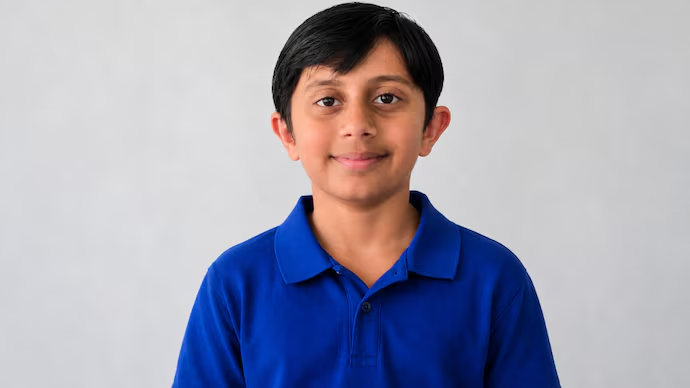
At such a young age, Purohit understands the greatest innovations start with solving a common problem. His “Tiny Batteries from Dirty Water” project explores using contaminated water as a component for generating small-scale electrical power.
The question is simple. How can unpotable water still provide an essential need? With Purohit’s ingenuity, he shifts the perspective of dirty water as merely a pollutant (oftentimes, dangerously so). “Tiny Batteries from Dirty Water” reframes this very valid problem into its own solution, transforming waste into a potential resource for small-scale energy production.
Purohit integrates both water quality and energy production within the same investigative framework. His ability to see beyond the limitations polluted water presents to a community garnered him the title 2026 North Carolina State Merit Winner in the 3M Young Scientist Challenge. The recognition places him among students nationwide whose work addresses real-world problems through science and technology.
The Young Scientist Lab doesn’t provide the details of Purohit’s project. While the general public isn’t privy to the specifications of, for example, battery design, materials, or the testing process, the bigger picture is the solution. At its core, “Tiny Batteries…” manages to provide the simplest solution to what is a complex problem.
Small batteries are essential for powering so much of our modern-day lives. Purohit investigates the functionality of waste materials in a world that almost seems to ignore rampant waste and pollution for the sake of convenience. Here, we have a young thinker who’s managed to provide a new angle: What if waste could be the answer to our need for convenience? This perspective ultimately fulfills the challenge’s original goal: to encourage students to tackle important issues through hands-on learning.
Indeed, according to The Young Scientist Lab’s official description, this annual challenge provides young students from grades 5-8 “the chance to change their world for the better with a single innovative idea. This premier science competition is a one-of-a-kind project-based learning opportunity designed to spark creativity, collaboration, and connection for students from every background.”
The Bright Side
Minds like Prakhar Purohit’s provide the foundation for some of the most significant innovations in human history. It oftentimes takes a younger mind, open to the possibilities the world has on display, to truly move civilization forward. Every day, children are born. As they grow and experience the world around them, they tend to approach things “darkly,” as in with no prior knowledge or real understanding of concepts made too complex by adults who create problems, then beg for solutions.
With a clean slate, wide-eyed desire for discovery, and an environment championing curiosity, anyone, even a middle schooler helping to solve practical problems for archeologists with his Tech Titan teammates, can change the world one small idea at a time.
Before you go…
Reset the Algorithm
Share one good story today.
For far too long, the internet has been fueled by outrage. We think it can run on something better. Join us, share a good story from The Bright Side, and help us reset the algorithm that determines what trends on the internet.
Leave a Reply
You must be logged in to post a comment.